
Evolving Automation Solutions for 40 Years in 2025 | Legacy 8.7
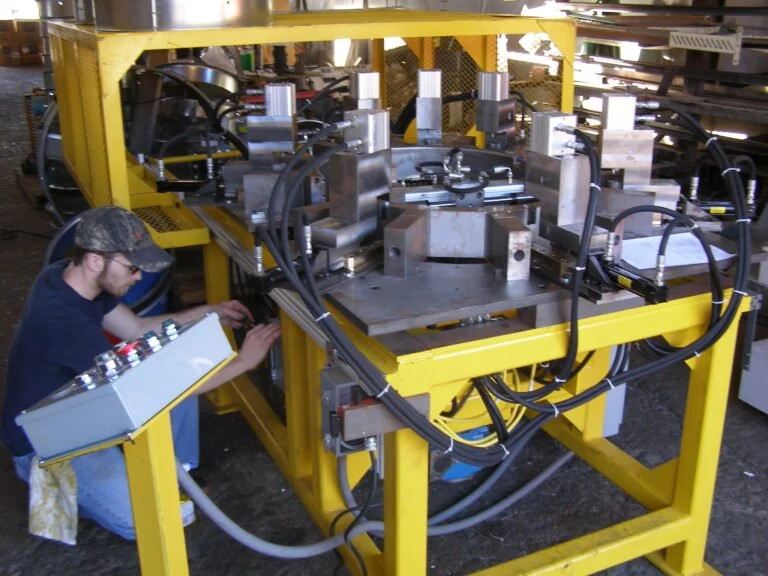
Venturi Machine | The purpose of this machine is to spin form a venturi fan shroud for an air conditioning unit. The machine utilizes hydraulics, a variable frequency drive, and numerous die tooling for spin forming and punching screw holes.
A Venturi machine (often called a Venturi system, Venturi pump, or Venturi vacuum) is a device that uses the Venturi effect to create suction or vacuum without any moving parts.
🔧 How it works
The Venturi effect happens when fluid (air, water, etc.) flows through a pipe that suddenly narrows, forcing the fluid to speed up.
As it speeds up, the pressure drops—and that low-pressure zone creates suction.
A Venturi machine typically works like this:
High-pressure air or fluid enters the device.
It passes through a narrow section (the Venturi).
The pressure drops, creating vacuum or suction.
This suction can pull in liquids, chemicals, or debris—or remove air.
🧰 Common uses of Venturi machines
Venturi systems are popular because they’re cheap, reliable, and have no moving parts. They're used for:
✔️ Industrial vacuum generation
Used in automation systems to power vacuum cups for material handling.
Common in welding shops, CNC facilities, and robotics.
✔️ Chemical and fertilizer injection (Venturi injectors)
Pulls chemicals into irrigation lines.
Used heavily in agriculture, pest control, and water treatment.
✔️ Vacuum generation in plumbing/HVAC
Used to clear lines, prime pumps, or evacuate air from pipes.
✔️ Liquid mixing and dosing
Great for mixing chemicals safely (because no electrical pump touches the fluid).
✔️ Laboratory and medical uses
Some medical aspirators use Venturi vacuum generators.
Example industries where Venturi machines are common:
Manufacturing & robotics
Welding & metal fabrication
Agriculture
Water treatment
Oil & gas
Construction & plumbing